

Close Menu
  • Main Home
  • About
    • Founder & CEO
    • The Challenge
    • Testimonials
    • In the Media
    • Gray Rhino Trademark Guidelines
    • Contact
  • Services
    • Speaking
    • Speaking Topics
      • TOP GLOBAL ECONOMY GRAY RHINOS
      • CLIMATE RISK GRAY RHINOS: STRATEGIC RESPONSES
      • GENDER AND RISK
      • THE RISK YOUR “FREE-FROM” FOOD BRAND CANNOT AFFORD TO TAKE
    • Workshop and Interactive Training Topics
      • RISK SKILLS IN THE FUTURE OF WORK
      • RISK FINGERPRINT FORENSICS
      • GRAY RHINO PROOFING YOUR FUTURE
    • Executive Masterclass – Risk Management
    • DCRO Risk Governance Institute
    • Earn the Mastering Gray Rhino® Governance Certificate
    • Strategic Advisory
    • NEW Microlearning Course: What’s Your Gray Rhino? [Personal version]
  • THE GRAY RHINO
    • Corporate Book Clubs
    • International Editions
      • Italian -Il Rinoceronte Grigio
      • Brazilian Portuguese -O Rinoceronte Cinza
      • Norwegian: GRÅ NESHORN
      • 灰犀牛 (Chinese Traditional Characters)
      • 灰犀牛 (Chinese Simplified Characters)
      • Korean: 회색 코뿔소가 온다
      • Hungarian: A szürke rinocérosz
    • Readers Guide
      • Media
  • YOU ARE WHAT YOU RISK
  • Gray Rhino Blog
    • The Horn
    • My Gray Rhino
    • Audio
    • Video
    • Quiz: How Rhino Ready Are You?
Facebook X (Twitter) Instagram
Trending
  • Constructing cognitive models using the gray rhino risk framework
  • Substack Gray Rhino Wrangler Short Series: the Big Ugly Debt Gray Rhino
  • Kerala’s Landslide Grey Rhino
  • IRM India Affiliate’s What’s the Risk?®️ – National Resilience In The Age of Polycrisis
  • Earn the Mastering Gray Rhino® Governance Certificate
  • The Gray Rhino microlearning course (personal version)
  • ARK Wealth Summit Hong Kong 2025: Reshaping Risk Awareness
  • On Substack: Wrangling this Gray Rhino Rampage
Facebook LinkedIn RSS
Gray Rhino & Company
Leaderboard Ad
  • Main Home
  • About
    • Founder & CEO
    • The Challenge
    • Testimonials
    • In the Media
    • Gray Rhino Trademark Guidelines
    • Contact
  • Services
    • Speaking
    • Speaking Topics
      • TOP GLOBAL ECONOMY GRAY RHINOS
      • CLIMATE RISK GRAY RHINOS: STRATEGIC RESPONSES
      • GENDER AND RISK
      • THE RISK YOUR “FREE-FROM” FOOD BRAND CANNOT AFFORD TO TAKE
    • Workshop and Interactive Training Topics
      • RISK SKILLS IN THE FUTURE OF WORK
      • RISK FINGERPRINT FORENSICS
      • GRAY RHINO PROOFING YOUR FUTURE
    • Executive Masterclass – Risk Management
    • DCRO Risk Governance Institute
    • Earn the Mastering Gray Rhino® Governance Certificate
    • Strategic Advisory
    • NEW Microlearning Course: What’s Your Gray Rhino? [Personal version]
  • THE GRAY RHINO
    • Corporate Book Clubs
    • International Editions
      • Italian -Il Rinoceronte Grigio
      • Brazilian Portuguese -O Rinoceronte Cinza
      • Norwegian: GRÅ NESHORN
      • 灰犀牛 (Chinese Traditional Characters)
      • 灰犀牛 (Chinese Simplified Characters)
      • Korean: 회색 코뿔소가 온다
      • Hungarian: A szürke rinocérosz
    • Readers Guide
      • Media
  • YOU ARE WHAT YOU RISK
  • Gray Rhino Blog
    • The Horn
    • My Gray Rhino
    • Audio
    • Video
    • Quiz: How Rhino Ready Are You?
Gray Rhino & Company
You are at:Home»Media»In the Media»FT BeyondBRICs: China’s Biggest Financial Risk Is the US

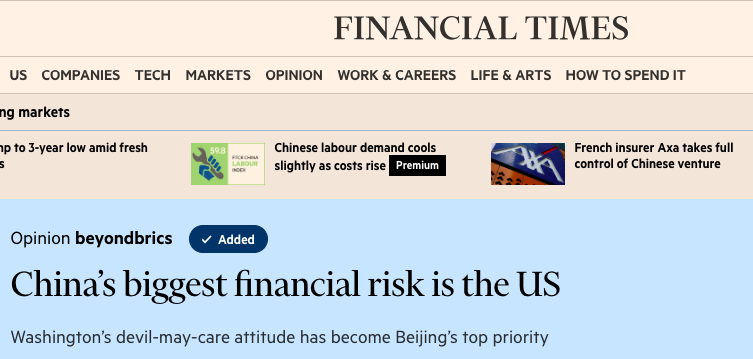
FT BeyondBRICs: China’s Biggest Financial Risk Is the US

0
By Michele Wucker on November 13, 2018 In the Media

Washington’s devil-may-care attitude has become Beijing’s top priority

Michele Wucker published this op-ed on the Financial Times beyondbrics blog November 13, 2018.

In its new annual financial stability report, China’s central bank has again sounded the alarm that “grey rhino” risks — clear and present dangers that are often neglected — continue to threaten the economy.

The report focused on China’s real estate market and high levels of local government, household and corporate debt, consistent with the concerns of Chinese and international observers.

Indeed, a popular narrative among western analysts is that China’s debt is a likely trigger for the next financial crisis. But the finger on that trigger is US complacency about risk.

President Xi Jinping has made containing financial risk a top priority and top officials have been vocal and active in addressing the danger areas they have identified.

By contrast, you could be forgiven for thinking that US officials had forgotten about the financial crisis that exploded a decade ago, not to mention the global dangers posed by 10 years of extremely loose monetary policy.

Washington’s approach appears to be to ignore warning signs and count on being able to frame the inevitable crash as a surprise “black swan” that “nobody saw coming”.

Yet many smart people do see trouble coming and are sounding urgent warnings for the US and the global economy. The International Monetary Fund warned in April that global debt had hit a new record high of $164tn, or 225 per cent of GDP. The US, it noted, is the only advanced economy where debt is outpacing economic growth.

Albert Edwards of SocGen forecast that financial winter is on the way, George F Will wrote of the giant sucking sound of a debt spiral, and Bridgewater’s Ray Dalio predicted a looming new debt crisis. Dozens of other smart analysts are sounding the alarm.

Well aware of the looming challenges, by contrast, China has been trying to gradually let the air out of credit bubbles without bursting them and to guide the economy to “quality growth” that may be slower but is more evenly distributed and less volatile.

Neither feat would be easy, even without having to wrangle external shocks caused by the US administration either not knowing or not caring about the global impact of its policies. China’s officials have been open about the real risks facing its economy, and made no secret of their intentions to cool off overheated sectors.

Using a combination of regulations, increased enforcement and liquidity controls, China has targeted the grey rhino risks that senior officials raised in a key five-year policy-setting meeting in July 2017: high corporate debt, excessive liquidity, shadow banking, capital market vulnerabilities, real estate bubbles, and emerging online financial products and services.

Regulators have cracked down on wealth management products marketed as “less risky” while promising higher yields. With corporate bond defaults up 40 per cent in the first half of 2018 and thousands of peer-to-peer lending platforms allowed to fail, China’s government has sent a message that people cannot count on it to fix every problem.

By contrast, Trump and senior officials have trumpeted US economic strength and downplayed risks and weaknesses.

Until the market volatility of the past few weeks, Trump had repeatedly bragged about how US shares were hitting record after record high, while China’s market indices were down more than 20 per cent for the year.

But a recent Council on Foreign Relations analysis shows how Chinese shares closely track a slowdown in credit growth over the past year or so. This suggests that much of the drop was the direct result of China’s efforts to let the air out of asset bubbles.

The Trump administration’s cavalier approach to financial risk increasingly suggests that its economic policies will not end well.

As the US Congress was preparing to pass a massive tax cut in December 2017, senior Chinese officials called the US tax plan a grey rhino, citing its potential impact on capital flows and financial stability. Responding quickly, Beijing developed a contingency plan involving higher interest rates, tighter capital controls and more active currency intervention.

The new Trump-supported tax cuts are widening the budget deficit while pushing up the cost of interest on the deficit. Even as financial risks increase, Washington has been chipping away at safeguards and emergency powers that could help contain the next crisis.

To be sure, the US Federal Reserve has been gradually increasing interest rates and shrinking its balance sheet, in a delayed attempt at normalising monetary policy. But this has created new global instabilities as money rushes out of emerging markets.

In contrast to China’s more surgical approach to specific vulnerabilities, the US relying mainly on interest rates as a broad-brush economic lever threatens to bring all boats down with it.

China is so concerned about this devil-may-care approach to financial risk that its politburo recently announced that dealing with US-generated economic shocks was an even higher priority than de-risking.

Paradoxically, current US-China policy threatens to slow down reforms that investors would like to see, such as reducing overcapacity at state-owned enterprises and intervening less in currency markets.

Trump’s bellicose rhetoric has ignored that China has been gradually opening its economy: easing foreign investment rules on 15 industries, particularly financial services, and evidence of some progress on intellectual property issues. Both of these are in China’s interest: it sees the benefit of increasing equity financing compared with debt, and it wants to encourage homegrown technological advances.

To counter the economic drag that trade war-related fears were creating, China has loosened its monetary policy in recent months. Its earlier belt-tightening gave it some wriggle room to do so.

But were China to completely abandon its de-risking strategy, it would resume heading towards a feared “Minsky moment” when the country’s ability to support debt collapses.

If the US paid as much attention as China does to the dangers lurking in the global economy and markets, it wouldn’t let itself appear to be so intent on throwing a monkey wrench into China’s sensible efforts to reduce financial risk.

Recall that demand from China for western goods, combined with China’s aggressive fiscal policy, played a big part in getting the world out of the 2008 crisis.

At one point, hopes that China would bail out Europe were dashed when Chinese officials rightly chided western governments for irresponsible economic policies.

Smart US policy would be to pay as much attention as China to heading off the grey rhino risks facing the global economy, and the role each country can play. An agreement ending the trade war would be a start. But unless the US takes financial risk more seriously, the threat to the global economy will remain — and China won’t be the main culprit.

Emerging markets guest forum beyondbrics is a forum on emerging markets for contributors from the worlds of business, finance, politics, academia and the third sector. 

Read this article at FT.com.

  • Author
  • Recent Posts
Michele Wucker
Follow
Michele Wucker
Founder & CEO at Gray Rhino & Company
Michele Wucker is a policy and business strategist and author of four books including YOU ARE WHAT YOU RISK: The New Art and Science of Navigating an Uncertain World and the global bestseller THE GRAY RHINO: How to Recognize and Act on the Obvious Dangers We Ignore. Read more about her at https://www.thegrayrhino.com/about/michelewucker
Michele Wucker
Follow
Latest posts by Michele Wucker (see all)
  • Constructing cognitive models using the gray rhino risk framework - October 15, 2025
  • Substack Gray Rhino Wrangler Short Series: the Big Ugly Debt Gray Rhino - September 30, 2025
  • Kerala’s Landslide Grey Rhino - September 15, 2025
China debt crisis economic policy financial risk risk policy United States
Share. Facebook Twitter Pinterest LinkedIn Tumblr Email
Michele Wucker
  • Website
  • Facebook
  • X (Twitter)
  • LinkedIn

Michele Wucker is a policy and business strategist and author of four books including YOU ARE WHAT YOU RISK: The New Art and Science of Navigating an Uncertain World and the global bestseller THE GRAY RHINO: How to Recognize and Act on the Obvious Dangers We Ignore. Read more about her at https://www.thegrayrhino.com/about/michelewucker

Related Posts

Constructing cognitive models using the gray rhino risk framework

Kerala’s Landslide Grey Rhino

ARK Wealth Summit Hong Kong 2025: Reshaping Risk Awareness

Comments are closed.

YOU ARE WHAT YOU RISK
YOU ARE WHAT YOU RISK Book Cover Click to order YOU ARE WHAT YOU RISK: The New Art and Science of Navigating an Uncertain World (Pegasus Books, April 6, 2021)
Book A Keynote or Workshop
Speakers Connect Sidebar Ad Book Gray Rhino & Company Founder & CEO Michele Wucker to speak at your next event. For more information  click on the logo  to contact Speakersconnect.

DCROI Risk Governance Institute
DCROI logo NEW! Earn the Mastering Gray Rhino Governance Certificate. Learn about DCROI's growing library of courses, networking, learning, and development opportunities focusing on the positive governance of risk-taking and the practical aspects of risk governance needed to pursue corporate goals and fulfill the purpose of our organizations.
BOOKSHOP.ORG STORE
Bookshop.org logo Shop at Bookshop.org and support independent booksellers. Browse our lists on business, decision making, current affairs, and more.
Leaderboard Ad
About
About

Gray Rhino® & Company provides a simple yet powerful framework, training and tools to help individuals, organizations, and communities to better counter and overcome obvious but too often neglected challenges in business, life, and the world.

Facebook LinkedIn
GRAY RHINO TRACKER Sign Up
Subscribe below for exclusive insights and updates in our monthly newsletter, The Gray Rhino® Tracker.

©2019
Gray Rhino & Company
4101 North Broadway, suite 104
Chicago, IL 60613-2104

  • About
  • Privacy Policy
  • Contact
©2016-2023 Gray Rhino & Company 5940 North Sheridan Road, Chicago, IL 60660
  • About
  • Privacy Policy
  • Contact

Type above and press Enter to search. Press Esc to cancel.

We use cookies on our website to give you the most relevant experience by remembering your preferences and repeat visits. By clicking “Accept”, you consent to the use of ALL the cookies.
Do not sell my personal information.
Cookie SettingsAccept
Manage consent

Privacy Overview

This website uses cookies to improve your experience while you navigate through the website. Out of these, the cookies that are categorized as necessary are stored on your browser as they are essential for the working of basic functionalities of the website. We also use third-party cookies that help us analyze and understand how you use this website. These cookies will be stored in your browser only with your consent. You also have the option to opt-out of these cookies. But opting out of some of these cookies may affect your browsing experience.
Necessary
Always Enabled
Necessary cookies are absolutely essential for the website to function properly. These cookies ensure basic functionalities and security features of the website, anonymously.
CookieDurationDescription
cookielawinfo-checkbox-analytics11 monthsThis cookie is set by GDPR Cookie Consent plugin. The cookie is used to store the user consent for the cookies in the category "Analytics".
cookielawinfo-checkbox-functional11 monthsThe cookie is set by GDPR cookie consent to record the user consent for the cookies in the category "Functional".
cookielawinfo-checkbox-necessary11 monthsThis cookie is set by GDPR Cookie Consent plugin. The cookies is used to store the user consent for the cookies in the category "Necessary".
cookielawinfo-checkbox-others11 monthsThis cookie is set by GDPR Cookie Consent plugin. The cookie is used to store the user consent for the cookies in the category "Other.
cookielawinfo-checkbox-performance11 monthsThis cookie is set by GDPR Cookie Consent plugin. The cookie is used to store the user consent for the cookies in the category "Performance".
viewed_cookie_policy11 monthsThe cookie is set by the GDPR Cookie Consent plugin and is used to store whether or not user has consented to the use of cookies. It does not store any personal data.
Functional
Functional cookies help to perform certain functionalities like sharing the content of the website on social media platforms, collect feedbacks, and other third-party features.
Performance
Performance cookies are used to understand and analyze the key performance indexes of the website which helps in delivering a better user experience for the visitors.
Analytics
Analytical cookies are used to understand how visitors interact with the website. These cookies help provide information on metrics the number of visitors, bounce rate, traffic source, etc.
Advertisement
Advertisement cookies are used to provide visitors with relevant ads and marketing campaigns. These cookies track visitors across websites and collect information to provide customized ads.
Others
Other uncategorized cookies are those that are being analyzed and have not been classified into a category as yet.
SAVE & ACCEPT