

Close Menu
  • Main Home
  • About
    • Founder & CEO
    • The Challenge
    • Testimonials
    • In the Media
    • Gray Rhino Trademark Guidelines
    • Contact
  • Services
    • Speaking
    • Speaking Topics
      • TOP GLOBAL ECONOMY GRAY RHINOS
      • CLIMATE RISK GRAY RHINOS: STRATEGIC RESPONSES
      • GENDER AND RISK
      • THE RISK YOUR “FREE-FROM” FOOD BRAND CANNOT AFFORD TO TAKE
    • Workshop and Interactive Training Topics
      • RISK SKILLS IN THE FUTURE OF WORK
      • RISK FINGERPRINT FORENSICS
      • GRAY RHINO PROOFING YOUR FUTURE
    • Executive Masterclass – Risk Management
    • DCRO Risk Governance Institute
    • Earn the Mastering Gray Rhino® Governance Certificate
    • Strategic Advisory
    • NEW Microlearning Course: What’s Your Gray Rhino? [Personal version]
  • THE GRAY RHINO
    • Corporate Book Clubs
    • International Editions
      • Italian -Il Rinoceronte Grigio
      • Brazilian Portuguese -O Rinoceronte Cinza
      • Norwegian: GRÅ NESHORN
      • 灰犀牛 (Chinese Traditional Characters)
      • 灰犀牛 (Chinese Simplified Characters)
      • Korean: 회색 코뿔소가 온다
      • Hungarian: A szürke rinocérosz
    • Readers Guide
      • Media
  • YOU ARE WHAT YOU RISK
  • Gray Rhino Blog
    • The Horn
    • My Gray Rhino
    • Audio
    • Video
    • Quiz: How Rhino Ready Are You?
Facebook X (Twitter) Instagram
Trending
  • Constructing cognitive models using the gray rhino risk framework
  • Substack Gray Rhino Wrangler Short Series: the Big Ugly Debt Gray Rhino
  • Kerala’s Landslide Grey Rhino
  • IRM India Affiliate’s What’s the Risk?®️ – National Resilience In The Age of Polycrisis
  • Earn the Mastering Gray Rhino® Governance Certificate
  • The Gray Rhino microlearning course (personal version)
  • ARK Wealth Summit Hong Kong 2025: Reshaping Risk Awareness
  • On Substack: Wrangling this Gray Rhino Rampage
Facebook LinkedIn RSS
Gray Rhino & Company
Leaderboard Ad
  • Main Home
  • About
    • Founder & CEO
    • The Challenge
    • Testimonials
    • In the Media
    • Gray Rhino Trademark Guidelines
    • Contact
  • Services
    • Speaking
    • Speaking Topics
      • TOP GLOBAL ECONOMY GRAY RHINOS
      • CLIMATE RISK GRAY RHINOS: STRATEGIC RESPONSES
      • GENDER AND RISK
      • THE RISK YOUR “FREE-FROM” FOOD BRAND CANNOT AFFORD TO TAKE
    • Workshop and Interactive Training Topics
      • RISK SKILLS IN THE FUTURE OF WORK
      • RISK FINGERPRINT FORENSICS
      • GRAY RHINO PROOFING YOUR FUTURE
    • Executive Masterclass – Risk Management
    • DCRO Risk Governance Institute
    • Earn the Mastering Gray Rhino® Governance Certificate
    • Strategic Advisory
    • NEW Microlearning Course: What’s Your Gray Rhino? [Personal version]
  • THE GRAY RHINO
    • Corporate Book Clubs
    • International Editions
      • Italian -Il Rinoceronte Grigio
      • Brazilian Portuguese -O Rinoceronte Cinza
      • Norwegian: GRÅ NESHORN
      • 灰犀牛 (Chinese Traditional Characters)
      • 灰犀牛 (Chinese Simplified Characters)
      • Korean: 회색 코뿔소가 온다
      • Hungarian: A szürke rinocérosz
    • Readers Guide
      • Media
  • YOU ARE WHAT YOU RISK
  • Gray Rhino Blog
    • The Horn
    • My Gray Rhino
    • Audio
    • Video
    • Quiz: How Rhino Ready Are You?
Gray Rhino & Company
You are at:Home»Blog»My Gray Rhino»Risks in Parenting, at Sea, and the Markets

Risks in Parenting, at Sea, and the Markets

0
By Michele Wucker on November 12, 2018 My Gray Rhino

For most of my career, when I’ve thought about risk it has involved specialized areas like sovereign credit risk, market risk, operational risk or political risk. But lately, I’ve been thinking a lot about how different “risk” in the financial sense is from the way people view risk in their day to day lives.

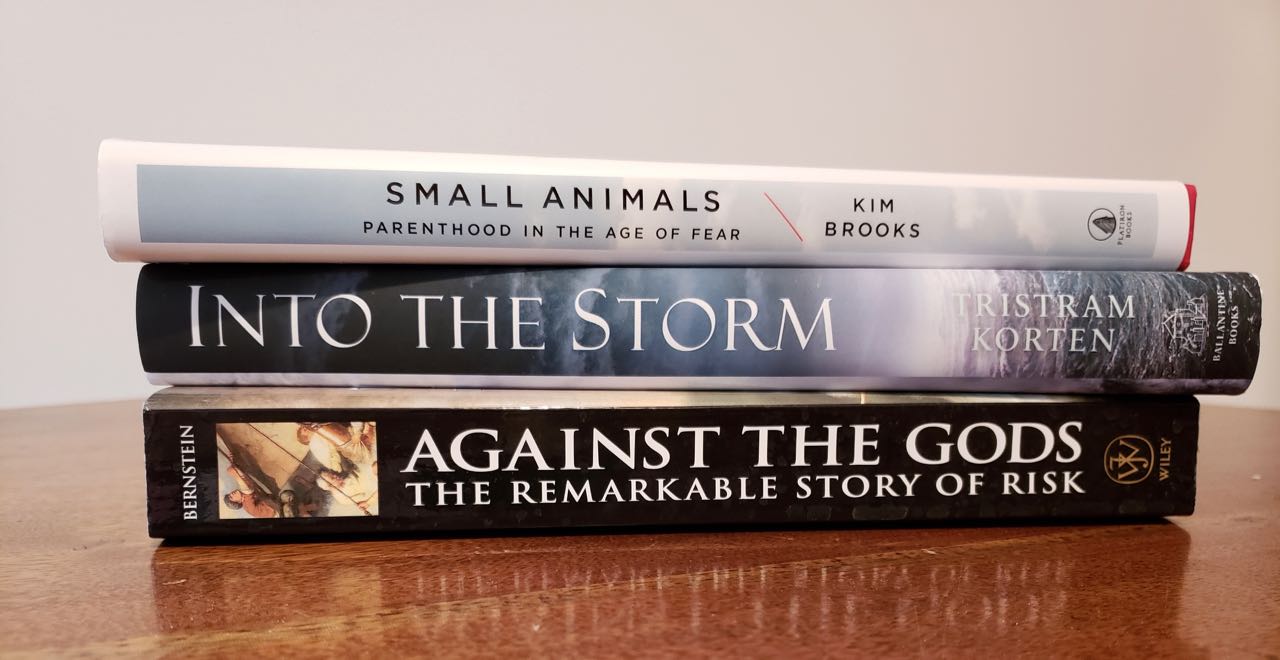
Peter Bernstein’s book Against the Gods: The Remarkable Story of Risk does a fantastic job describing the evolution of conceptions of risk throughout history. He tracks gambling from the ancient astragalus dice game played with the ankle bone of sheep or deer, through Asian card games and the more recent games of craps and poker. He follows the thinking of ancient Greeks and Talmudic scholars to Fibonacci’s thirteenth-century advances, to mathematical concepts of risk from the Renaissance through the nineteenth century. He delves into John Maynard Keynes’ framing of perceptions and judgments on estimates of probability; Nobel laureate Kenneth Arrow’s work on insurance and decisions under conditions of uncertainty; and applications of utility theory, game theory, chaos theory, and prospect theory. And he shows how the sweep of ideas over history have shaped modern financial markets.

The finance world still looks to Frank Knight’s classic technical definition, under which “risk” is quantifiable and insurable, where “uncertainty” is not. In markets, this view often leads to problems because all too often, risks that are set down on paper -in a credit rating, price or yield- rest on an illusion. Whoever assigns value does so based on certain combinations of fact and bias. All too often, their guesses are off the mark, as we saw during the 2008-09 financial crisis when many ratings agencies’ risk assessments turned out to be way off the mark.

Apart from the problems that come from an overly technical view of risk, the reality is that most of us think of risk and uncertainty as being closely intertwined. It’s a completely different conversation and concept from what takes place in the financial markets. The more retail investors there are in the market, the more dangerous this conceptual gap becomes.

In that light, insights from two recent books on risk in “real life” take on new meaning. One involves systemic failures to recognize risk, while the other calls out misguided efforts to reduce risks beyond a reasonable level. An added bonus is that both books happen to be great reads.

INTO THE STORM: Two Ships, a Deadly Hurricane, and an Epic Battle for Survival, my long-time friend Tristram Korten’s real-life account of two ships and Hurricane Joaquin. In researching this story, Tris interviewed scores of survivors, family members, experts and authorities, and pored through five hundred pages of devastating transcripts of conversations from one of the ships.

The sheer number of risk decisions that together determined the fates of the ships and their crews—policy choices like the Jones Act, inspection protocols weakened by industry lobbyists, the failure to upgrade safety equipment on aging ships (and the laws that made those decisions legal), which course to set weather data, protocol, and rescue strategy—boggles the mind. That’s even before mentioning the impact of climate change on the strength of storms, the economics of the shipping industry pushing ships past their life expectancies –giving new meaning to the term “rust bucket,” and delays in weather condition updates.

I don’t think it’s too much of a spoiler to share this description of one of the ships: “As the raft drifted away from the ship into the dark and vast sea, a thought too terrible began to creep into the sailors’ minds: If thousands of pounds of steel couldn’t protect them, what chance did they have with only a few millimeters of rubber and canvas separating them from the depths?”

A very different book, Kim Brooks’ SMALL ANIMALS: Parenthood in the Age of Fear is a sobering story and compelling analysis of what’s wrong with how Americans have come to view risk. She recounts the legal and emotional ordeal that ensued after she left her four-year-old son in a car in a parking lot for a few minutes on a day where he was in no danger from heat or cold, in a safe suburban community where she’d grown up — where parents when she was growing up could leave their kids in cars in safe weather without worrying about being arrested.

Brooks cites Centers for Disease Control numbers that statistically speaking, a child would have to be left alone in public for 750,000 years to be snatched by a stranger. Yes, you read that right.

Brooks illustrates several important points. First, that “the object of fear correlates less to the level of risk than to parents’ ability (or perceived ability) to exert control over the outcome.” Second, that risk assessment and fear of moral judgment are closely related. She cites research by the cognitive scientist Barbara Sarnecka showing that the higher people’s moral outrage at a parent’s reason for leaving, the more danger they are likely to estimate faces a child.

Brooks asks –then provides some compelling answers- what the cost is of fear-based policies that lead to cases like hers and what the effects are of their unequal impact on fathers and mothers, rich and poor.

With all the recent volatility in financial markets, it’s worth reflecting on the risk attitudes that drive investment decisions -and remembering that markets often behave more like the real world than most investment professionals would like to think.

#risk #ideas #books #systemsthinking #fear #uncertainty

  • Author
  • Recent Posts
Michele Wucker
Follow
Michele Wucker
Founder & CEO at Gray Rhino & Company
Michele Wucker is a policy and business strategist and author of four books including YOU ARE WHAT YOU RISK: The New Art and Science of Navigating an Uncertain World and the global bestseller THE GRAY RHINO: How to Recognize and Act on the Obvious Dangers We Ignore. Read more about her at https://www.thegrayrhino.com/about/michelewucker
Michele Wucker
Follow
Latest posts by Michele Wucker (see all)
  • Constructing cognitive models using the gray rhino risk framework - October 15, 2025
  • Substack Gray Rhino Wrangler Short Series: the Big Ugly Debt Gray Rhino - September 30, 2025
  • Kerala’s Landslide Grey Rhino - September 15, 2025
Share. Facebook Twitter Pinterest LinkedIn Tumblr Email
Michele Wucker
  • Website
  • Facebook
  • X (Twitter)
  • LinkedIn

Michele Wucker is a policy and business strategist and author of four books including YOU ARE WHAT YOU RISK: The New Art and Science of Navigating an Uncertain World and the global bestseller THE GRAY RHINO: How to Recognize and Act on the Obvious Dangers We Ignore. Read more about her at https://www.thegrayrhino.com/about/michelewucker

Related Posts

Earn the Mastering Gray Rhino® Governance Certificate

The Gray Rhino microlearning course (personal version)

Don’t Risk Ignoring Relationships

Comments are closed.

YOU ARE WHAT YOU RISK
YOU ARE WHAT YOU RISK Book Cover Click to order YOU ARE WHAT YOU RISK: The New Art and Science of Navigating an Uncertain World (Pegasus Books, April 6, 2021)
Book A Keynote or Workshop
Speakers Connect Sidebar Ad Book Gray Rhino & Company Founder & CEO Michele Wucker to speak at your next event. For more information  click on the logo  to contact Speakersconnect.

DCROI Risk Governance Institute
DCROI logo NEW! Earn the Mastering Gray Rhino Governance Certificate. Learn about DCROI's growing library of courses, networking, learning, and development opportunities focusing on the positive governance of risk-taking and the practical aspects of risk governance needed to pursue corporate goals and fulfill the purpose of our organizations.
BOOKSHOP.ORG STORE
Bookshop.org logo Shop at Bookshop.org and support independent booksellers. Browse our lists on business, decision making, current affairs, and more.
About
About

Gray Rhino® & Company provides a simple yet powerful framework, training and tools to help individuals, organizations, and communities to better counter and overcome obvious but too often neglected challenges in business, life, and the world.

Facebook LinkedIn
GRAY RHINO TRACKER Sign Up
Subscribe below for exclusive insights and updates in our monthly newsletter, The Gray Rhino® Tracker.
©2016-2023 Gray Rhino & Company 5940 North Sheridan Road, Chicago, IL 60660
  • About
  • Privacy Policy
  • Contact

Type above and press Enter to search. Press Esc to cancel.

We use cookies on our website to give you the most relevant experience by remembering your preferences and repeat visits. By clicking “Accept”, you consent to the use of ALL the cookies.
Do not sell my personal information.
Cookie SettingsAccept
Manage consent

Privacy Overview

This website uses cookies to improve your experience while you navigate through the website. Out of these, the cookies that are categorized as necessary are stored on your browser as they are essential for the working of basic functionalities of the website. We also use third-party cookies that help us analyze and understand how you use this website. These cookies will be stored in your browser only with your consent. You also have the option to opt-out of these cookies. But opting out of some of these cookies may affect your browsing experience.
Necessary
Always Enabled
Necessary cookies are absolutely essential for the website to function properly. These cookies ensure basic functionalities and security features of the website, anonymously.
CookieDurationDescription
cookielawinfo-checkbox-analytics11 monthsThis cookie is set by GDPR Cookie Consent plugin. The cookie is used to store the user consent for the cookies in the category "Analytics".
cookielawinfo-checkbox-functional11 monthsThe cookie is set by GDPR cookie consent to record the user consent for the cookies in the category "Functional".
cookielawinfo-checkbox-necessary11 monthsThis cookie is set by GDPR Cookie Consent plugin. The cookies is used to store the user consent for the cookies in the category "Necessary".
cookielawinfo-checkbox-others11 monthsThis cookie is set by GDPR Cookie Consent plugin. The cookie is used to store the user consent for the cookies in the category "Other.
cookielawinfo-checkbox-performance11 monthsThis cookie is set by GDPR Cookie Consent plugin. The cookie is used to store the user consent for the cookies in the category "Performance".
viewed_cookie_policy11 monthsThe cookie is set by the GDPR Cookie Consent plugin and is used to store whether or not user has consented to the use of cookies. It does not store any personal data.
Functional
Functional cookies help to perform certain functionalities like sharing the content of the website on social media platforms, collect feedbacks, and other third-party features.
Performance
Performance cookies are used to understand and analyze the key performance indexes of the website which helps in delivering a better user experience for the visitors.
Analytics
Analytical cookies are used to understand how visitors interact with the website. These cookies help provide information on metrics the number of visitors, bounce rate, traffic source, etc.
Advertisement
Advertisement cookies are used to provide visitors with relevant ads and marketing campaigns. These cookies track visitors across websites and collect information to provide customized ads.
Others
Other uncategorized cookies are those that are being analyzed and have not been classified into a category as yet.
SAVE & ACCEPT