

Close Menu
  • Main Home
  • About
    • Founder & CEO
    • The Challenge
    • Testimonials
    • In the Media
    • Gray Rhino Trademark Guidelines
    • Contact
  • Services
    • Speaking
    • Speaking Topics
      • TOP GLOBAL ECONOMY GRAY RHINOS
      • CLIMATE RISK GRAY RHINOS: STRATEGIC RESPONSES
      • GENDER AND RISK
      • THE RISK YOUR “FREE-FROM” FOOD BRAND CANNOT AFFORD TO TAKE
    • Workshop and Interactive Training Topics
      • RISK SKILLS IN THE FUTURE OF WORK
      • RISK FINGERPRINT FORENSICS
      • GRAY RHINO PROOFING YOUR FUTURE
    • Executive Masterclass – Risk Management
    • DCRO Risk Governance Institute
    • Earn the Mastering Gray Rhino® Governance Certificate
    • Strategic Advisory
    • NEW Microlearning Course: What’s Your Gray Rhino? [Personal version]
  • THE GRAY RHINO
    • Corporate Book Clubs
    • International Editions
      • Italian -Il Rinoceronte Grigio
      • Brazilian Portuguese -O Rinoceronte Cinza
      • Norwegian: GRÅ NESHORN
      • 灰犀牛 (Chinese Traditional Characters)
      • 灰犀牛 (Chinese Simplified Characters)
      • Korean: 회색 코뿔소가 온다
      • Hungarian: A szürke rinocérosz
    • Readers Guide
      • Media
  • YOU ARE WHAT YOU RISK
  • Gray Rhino Blog
    • The Horn
    • My Gray Rhino
    • Audio
    • Video
    • Quiz: How Rhino Ready Are You?
Facebook X (Twitter) Instagram
Trending
  • Constructing cognitive models using the gray rhino risk framework
  • Substack Gray Rhino Wrangler Short Series: the Big Ugly Debt Gray Rhino
  • Kerala’s Landslide Grey Rhino
  • IRM India Affiliate’s What’s the Risk?®️ – National Resilience In The Age of Polycrisis
  • Earn the Mastering Gray Rhino® Governance Certificate
  • The Gray Rhino microlearning course (personal version)
  • ARK Wealth Summit Hong Kong 2025: Reshaping Risk Awareness
  • On Substack: Wrangling this Gray Rhino Rampage
Facebook LinkedIn RSS
Gray Rhino & Company
Leaderboard Ad
  • Main Home
  • About
    • Founder & CEO
    • The Challenge
    • Testimonials
    • In the Media
    • Gray Rhino Trademark Guidelines
    • Contact
  • Services
    • Speaking
    • Speaking Topics
      • TOP GLOBAL ECONOMY GRAY RHINOS
      • CLIMATE RISK GRAY RHINOS: STRATEGIC RESPONSES
      • GENDER AND RISK
      • THE RISK YOUR “FREE-FROM” FOOD BRAND CANNOT AFFORD TO TAKE
    • Workshop and Interactive Training Topics
      • RISK SKILLS IN THE FUTURE OF WORK
      • RISK FINGERPRINT FORENSICS
      • GRAY RHINO PROOFING YOUR FUTURE
    • Executive Masterclass – Risk Management
    • DCRO Risk Governance Institute
    • Earn the Mastering Gray Rhino® Governance Certificate
    • Strategic Advisory
    • NEW Microlearning Course: What’s Your Gray Rhino? [Personal version]
  • THE GRAY RHINO
    • Corporate Book Clubs
    • International Editions
      • Italian -Il Rinoceronte Grigio
      • Brazilian Portuguese -O Rinoceronte Cinza
      • Norwegian: GRÅ NESHORN
      • 灰犀牛 (Chinese Traditional Characters)
      • 灰犀牛 (Chinese Simplified Characters)
      • Korean: 회색 코뿔소가 온다
      • Hungarian: A szürke rinocérosz
    • Readers Guide
      • Media
  • YOU ARE WHAT YOU RISK
  • Gray Rhino Blog
    • The Horn
    • My Gray Rhino
    • Audio
    • Video
    • Quiz: How Rhino Ready Are You?
Gray Rhino & Company
You are at:Home»Blog»My Gray Rhino»How to Combat COVID19 Denial
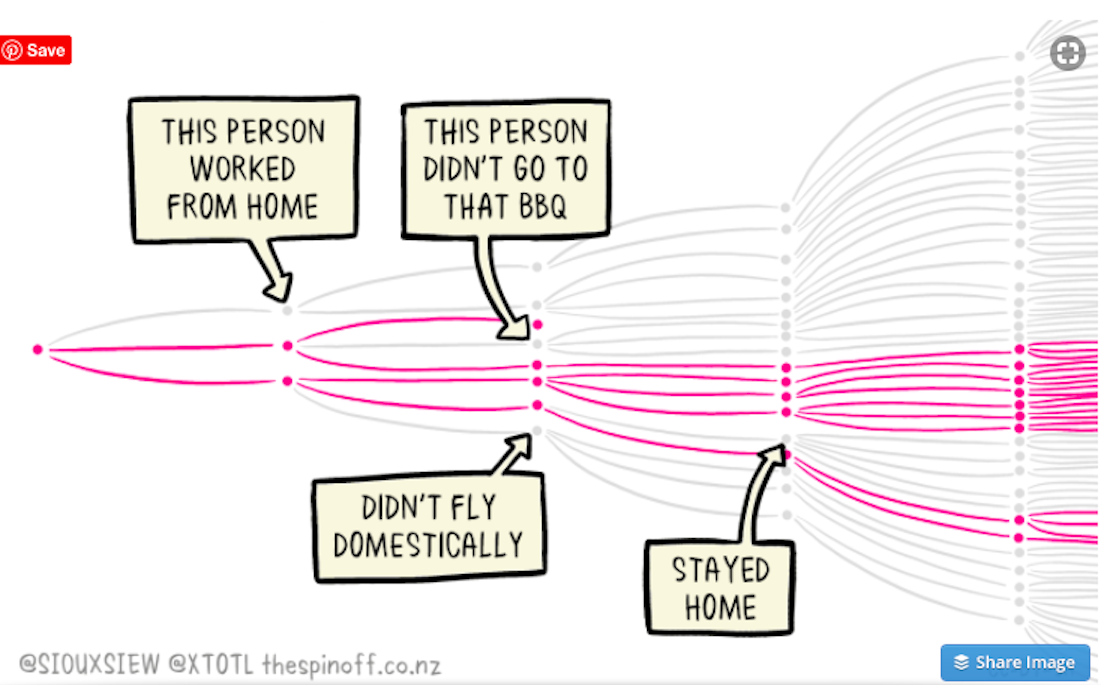
graphic showing how much more virus spreads if people don't stay home
Graphic thanks to @SIOUXSIEW @XTOTL from https://thespinoff.co.nz

How to Combat COVID19 Denial

0
By Michele Wucker on March 25, 2020 My Gray Rhino

Why are people so prone to denying instead of dealing with the obvious problems in front of us, whether coronavirus or climate change or financial fragilities?

Last week I wrote about the five stages of a gray rhino crisis, the first one being denial. This week I want to dive a lot deeper into denial: Why do we do it? Why are some people more prone to it than others? And most important, how do we snap ourselves and others out of denial as soon as possible?

Denial is a powerful force, often rooted in primal emotions. It’s a protective quirk of human nature: often if we fully accepted the extent of some shocks all at once, it would be too much. Denial allows us to function so that we can gradually move toward acceptance. If it works as nature intended and only sticks around temporarily, denial can be helpful. But if it does not dissipate, denial can be catastrophic.

All of us deny to different degrees and deal with shocks in our own ways, but none of us is immune. To be honest, though I spend my days thinking about the crisis we are in and sharing my insights with others, I am in a semi-numb state in which the reality hasn’t completely hit emotionally –though the tension in my neck and shoulders suggests that it’s registered physically.

My way of dealing with difficult situations is to think them through, and I could reasonably be accused of over intellectualizing at times: that’s my coping strategy. It takes effort for me to embrace the emotional side. I remember not crying until weeks after a close friend’s funeral. It took that long after losing her to get past my defenses.

Part of understanding why you and those around you deny a problem is to recognize that there are both emotional and logical components. It’s also true that sometimes “logic” doesn’t work the way we think it should; we might think we’re reasoning through when we’re being irrational, responding to deep-seated biases and defense mechanisms.

But there are things that can break through the shield of denial. Emotion and human connections are the most powerful, especially combined with some of the other strategies below.

Emotional connections. The more people start seeing those they know and the closer those relationships are, the more likely they are to take the virus seriously.

Over the past few days, I’ve seen a steady increase in mentions of friends and relatives of people I know who are dying from the virus. At least three friends have contracted it and, luckily, are in late stages of recovery.

Manu Dibango, a global treasure, just died from COVID-19 related complications.

The number of global and local public figures being diagnosed is rising: Prince Charles, the husband of Sen. Amy Klobuchar, the wife of Canadian Prime Minister Justin Trudeau, the physician of German Chancellor Angela Merkel, and many more. Though the vast majority of people are not close to them, the more recognizable figures are affected, the harder it becomes to ignore the reach of the virus.

Thinking of others. When I used to run a not-for-profit organization and was getting a crash course in fundraising, one of the important lessons I learned about asking for money was that it was much more comfortable remembering that I was not asking for myself, but for a bigger cause to support others.

In fact, research suggests that urge people to stay home because of others’ safety is more effective than warning them about the danger to themselves. Part of that is because humans are biased to be overconfident of our own ability to manage a situation.

So we can see dangers better when we imagine how they will affect other people, especially those close to us. Take a look and listen to this powerful 18 second message and just try to tell me it doesn’t move you:

I’ve spoken with friends with chronic medical conditions and ongoing needs who are worried that they will not be able to get regular care like plasma infusions or cancer monitoring, because their doctors have closed their offices, or because they are afraid of exposing themselves by going in to a medical facility. Since I suffer from celiac disease, intermittent asthma, and other autoimmune challenges, I can relate all too well.

Staying home, urging others to do so too, countering misinformation and spreading the best information I can find all help the many vulnerable people about whom I care even a little bit –and everyone like them.

Recognizing manufactured denial. Sometimes the wrong people understand all too well the depths of our human biases and how susceptible we are to information we want to hear –and they use their knowledge to manipulate us.

The late German sociologist Ulrich Beck wrote about the way governments and media “stage” risks: they portray risks the way they want us to see them, which generally is the way that is to their advantage, rather than as these risks are in reality.

The historians Naomi Oreskes and Erik Conway have shown eloquently how this works in their book Merchants of Doubt about how corporations have sown disinformation about climate change, tobacco and more.

It’s clear that there are partisan differences in perceptions of the coronavirus, in part because people of different political persuasions tend to go to different news sources. Perceptions within each party vary as well depending on which media they relied on to get information.

How do you combat manufactured denial? Be aware of it. Watch media from different perspectives, including those you may not agree with. Ask yourself who benefits from a particular narrative and how self interest shapes the story you are hearing.

Peer pressure. Behavioral economists talk about groupthink, the phenomenon whereby groups are likely to suppress dissenting opinions –particularly in groups that do not include diverse backgrounds and perspectives. Groupthink can reinforce denial –or it can encourage buy-in.

While groupthink often involves bias of which group members are not aware, peer pressure is an active process of getting group members to conform. It can either counter our natural tendency toward denial or reinforce it.

All those pictures of college kids on spring break on the beach and on boats, most definitely not practicing social distancing, is an example of how peer pressure can have a negative effect. But the more people come out and say that they are staying at home, washing hands regularly, avoiding unnecessary social contact, the more others are likely to do so too.

Fans of The Bachelor franchise may have noticed a tension in this dynamic between stars of recent seasons who are partying hard in Florida as part of a group that calls itself “the quarantine crew” and scolding by former Bachelor Nick Viall, who suggested that they were not being good role models by their blatant disregard of social distancing recommendations.

On Facebook, I recently followed the lead of a friend who added a “Stay Home. Save Lives. #quaranteam” frame to their profile picture. While during past crises many people have derided Facebook “slacktivism,” right now the platform has potential to reinforce the message that many people do take the crisis seriously. But users also need to be vigilant about combating a flood of misinformation.

Visual imagery. Research shows that social media posts with images are more likely to be shared than text-only posts. Other research shows that people retain significantly more information from visuals than from words alone. The power of visual imagery can be helpful for combating denial.

This is one of the best graphics I’ve seen to illustrate how social distancing and shelter at home can combat the virus:

No alt text provided for this image

Similarly, Tomas Pueyo’s viral essay, The Hammer and the Dance, is chock full of powerful charts and graphs.

No alt text provided for this image

And my personal favorite is the Sesame Street character, Grover, giving a great demonstration of how to do social distancing:

I hope that some or all of these insights are useful, either in fighting off your own denial or in convincing the naysayers around you to join in an effort that depends on everyone doing their share.

For more about denial, see Chapter Three of THE GRAY RHINO: How to Recognize and Act on the Obvious Dangers We Ignore.

This article is part of my new LinkedIn newsletter series, “Around My Mind” – a regular walk through the ideas, events, people, and places that kick my synapses into action, sparking sometimes surprising or counter-intuitive connections. 

To subscribe to “Around My Mind” and get notifications of new posts, click the blue button on the top right hand on this page. Please don’t be shy about sharing, leaving comments or dropping me a private note with your own reactions.

  • Author
  • Recent Posts
Michele Wucker
Follow
Michele Wucker
Founder & CEO at Gray Rhino & Company
Michele Wucker is a policy and business strategist and author of four books including YOU ARE WHAT YOU RISK: The New Art and Science of Navigating an Uncertain World and the global bestseller THE GRAY RHINO: How to Recognize and Act on the Obvious Dangers We Ignore. Read more about her at https://www.thegrayrhino.com/about/michelewucker
Michele Wucker
Follow
Latest posts by Michele Wucker (see all)
  • Constructing cognitive models using the gray rhino risk framework - October 15, 2025
  • Substack Gray Rhino Wrangler Short Series: the Big Ugly Debt Gray Rhino - September 30, 2025
  • Kerala’s Landslide Grey Rhino - September 15, 2025
cognitive bias coronavirus COVID-19 denial infodemic
Share. Facebook Twitter Pinterest LinkedIn Tumblr Email
Michele Wucker
  • Website
  • Facebook
  • X (Twitter)
  • LinkedIn

Michele Wucker is a policy and business strategist and author of four books including YOU ARE WHAT YOU RISK: The New Art and Science of Navigating an Uncertain World and the global bestseller THE GRAY RHINO: How to Recognize and Act on the Obvious Dangers We Ignore. Read more about her at https://www.thegrayrhino.com/about/michelewucker

Related Posts

Earn the Mastering Gray Rhino® Governance Certificate

The Gray Rhino microlearning course (personal version)

Don’t Risk Ignoring Relationships

Comments are closed.

YOU ARE WHAT YOU RISK
YOU ARE WHAT YOU RISK Book Cover Click to order YOU ARE WHAT YOU RISK: The New Art and Science of Navigating an Uncertain World (Pegasus Books, April 6, 2021)
Book A Keynote or Workshop
Speakers Connect Sidebar Ad Book Gray Rhino & Company Founder & CEO Michele Wucker to speak at your next event. For more information  click on the logo  to contact Speakersconnect.

DCROI Risk Governance Institute
DCROI logo NEW! Earn the Mastering Gray Rhino Governance Certificate. Learn about DCROI's growing library of courses, networking, learning, and development opportunities focusing on the positive governance of risk-taking and the practical aspects of risk governance needed to pursue corporate goals and fulfill the purpose of our organizations.
BOOKSHOP.ORG STORE
Bookshop.org logo Shop at Bookshop.org and support independent booksellers. Browse our lists on business, decision making, current affairs, and more.
About
About

Gray Rhino® & Company provides a simple yet powerful framework, training and tools to help individuals, organizations, and communities to better counter and overcome obvious but too often neglected challenges in business, life, and the world.

Facebook LinkedIn
GRAY RHINO TRACKER Sign Up
Subscribe below for exclusive insights and updates in our monthly newsletter, The Gray Rhino® Tracker.
©2016-2023 Gray Rhino & Company 5940 North Sheridan Road, Chicago, IL 60660
  • About
  • Privacy Policy
  • Contact

Type above and press Enter to search. Press Esc to cancel.

We use cookies on our website to give you the most relevant experience by remembering your preferences and repeat visits. By clicking “Accept”, you consent to the use of ALL the cookies.
Do not sell my personal information.
Cookie SettingsAccept
Manage consent

Privacy Overview

This website uses cookies to improve your experience while you navigate through the website. Out of these, the cookies that are categorized as necessary are stored on your browser as they are essential for the working of basic functionalities of the website. We also use third-party cookies that help us analyze and understand how you use this website. These cookies will be stored in your browser only with your consent. You also have the option to opt-out of these cookies. But opting out of some of these cookies may affect your browsing experience.
Necessary
Always Enabled
Necessary cookies are absolutely essential for the website to function properly. These cookies ensure basic functionalities and security features of the website, anonymously.
CookieDurationDescription
cookielawinfo-checkbox-analytics11 monthsThis cookie is set by GDPR Cookie Consent plugin. The cookie is used to store the user consent for the cookies in the category "Analytics".
cookielawinfo-checkbox-functional11 monthsThe cookie is set by GDPR cookie consent to record the user consent for the cookies in the category "Functional".
cookielawinfo-checkbox-necessary11 monthsThis cookie is set by GDPR Cookie Consent plugin. The cookies is used to store the user consent for the cookies in the category "Necessary".
cookielawinfo-checkbox-others11 monthsThis cookie is set by GDPR Cookie Consent plugin. The cookie is used to store the user consent for the cookies in the category "Other.
cookielawinfo-checkbox-performance11 monthsThis cookie is set by GDPR Cookie Consent plugin. The cookie is used to store the user consent for the cookies in the category "Performance".
viewed_cookie_policy11 monthsThe cookie is set by the GDPR Cookie Consent plugin and is used to store whether or not user has consented to the use of cookies. It does not store any personal data.
Functional
Functional cookies help to perform certain functionalities like sharing the content of the website on social media platforms, collect feedbacks, and other third-party features.
Performance
Performance cookies are used to understand and analyze the key performance indexes of the website which helps in delivering a better user experience for the visitors.
Analytics
Analytical cookies are used to understand how visitors interact with the website. These cookies help provide information on metrics the number of visitors, bounce rate, traffic source, etc.
Advertisement
Advertisement cookies are used to provide visitors with relevant ads and marketing campaigns. These cookies track visitors across websites and collect information to provide customized ads.
Others
Other uncategorized cookies are those that are being analyzed and have not been classified into a category as yet.
SAVE & ACCEPT