

Close Menu
  • Main Home
  • About
    • Founder & CEO
    • The Challenge
    • Testimonials
    • In the Media
    • Gray Rhino Trademark Guidelines
    • Contact
  • Services
    • Speaking
    • Speaking Topics
      • TOP GLOBAL ECONOMY GRAY RHINOS
      • CLIMATE RISK GRAY RHINOS: STRATEGIC RESPONSES
      • GENDER AND RISK
      • THE RISK YOUR “FREE-FROM” FOOD BRAND CANNOT AFFORD TO TAKE
    • Workshop and Interactive Training Topics
      • RISK SKILLS IN THE FUTURE OF WORK
      • RISK FINGERPRINT FORENSICS
      • GRAY RHINO PROOFING YOUR FUTURE
    • Executive Masterclass – Risk Management
    • DCRO Risk Governance Institute
    • Earn the Mastering Gray Rhino® Governance Certificate
    • Strategic Advisory
    • NEW Microlearning Course: What’s Your Gray Rhino? [Personal version]
  • THE GRAY RHINO
    • Corporate Book Clubs
    • International Editions
      • Italian -Il Rinoceronte Grigio
      • Brazilian Portuguese -O Rinoceronte Cinza
      • Norwegian: GRÅ NESHORN
      • 灰犀牛 (Chinese Traditional Characters)
      • 灰犀牛 (Chinese Simplified Characters)
      • Korean: 회색 코뿔소가 온다
      • Hungarian: A szürke rinocérosz
    • Readers Guide
      • Media
  • YOU ARE WHAT YOU RISK
  • Gray Rhino Blog
    • The Horn
    • My Gray Rhino
    • Audio
    • Video
    • Quiz: How Rhino Ready Are You?
Facebook X (Twitter) Instagram
Trending
  • Constructing cognitive models using the gray rhino risk framework
  • Substack Gray Rhino Wrangler Short Series: the Big Ugly Debt Gray Rhino
  • Kerala’s Landslide Grey Rhino
  • IRM India Affiliate’s What’s the Risk?®️ – National Resilience In The Age of Polycrisis
  • Earn the Mastering Gray Rhino® Governance Certificate
  • The Gray Rhino microlearning course (personal version)
  • ARK Wealth Summit Hong Kong 2025: Reshaping Risk Awareness
  • On Substack: Wrangling this Gray Rhino Rampage
Facebook LinkedIn RSS
Gray Rhino & Company
Leaderboard Ad
  • Main Home
  • About
    • Founder & CEO
    • The Challenge
    • Testimonials
    • In the Media
    • Gray Rhino Trademark Guidelines
    • Contact
  • Services
    • Speaking
    • Speaking Topics
      • TOP GLOBAL ECONOMY GRAY RHINOS
      • CLIMATE RISK GRAY RHINOS: STRATEGIC RESPONSES
      • GENDER AND RISK
      • THE RISK YOUR “FREE-FROM” FOOD BRAND CANNOT AFFORD TO TAKE
    • Workshop and Interactive Training Topics
      • RISK SKILLS IN THE FUTURE OF WORK
      • RISK FINGERPRINT FORENSICS
      • GRAY RHINO PROOFING YOUR FUTURE
    • Executive Masterclass – Risk Management
    • DCRO Risk Governance Institute
    • Earn the Mastering Gray Rhino® Governance Certificate
    • Strategic Advisory
    • NEW Microlearning Course: What’s Your Gray Rhino? [Personal version]
  • THE GRAY RHINO
    • Corporate Book Clubs
    • International Editions
      • Italian -Il Rinoceronte Grigio
      • Brazilian Portuguese -O Rinoceronte Cinza
      • Norwegian: GRÅ NESHORN
      • 灰犀牛 (Chinese Traditional Characters)
      • 灰犀牛 (Chinese Simplified Characters)
      • Korean: 회색 코뿔소가 온다
      • Hungarian: A szürke rinocérosz
    • Readers Guide
      • Media
  • YOU ARE WHAT YOU RISK
  • Gray Rhino Blog
    • The Horn
    • My Gray Rhino
    • Audio
    • Video
    • Quiz: How Rhino Ready Are You?
Gray Rhino & Company
You are at:Home»Blog»The Horn»How the War in Ukraine Affects the Global Economy
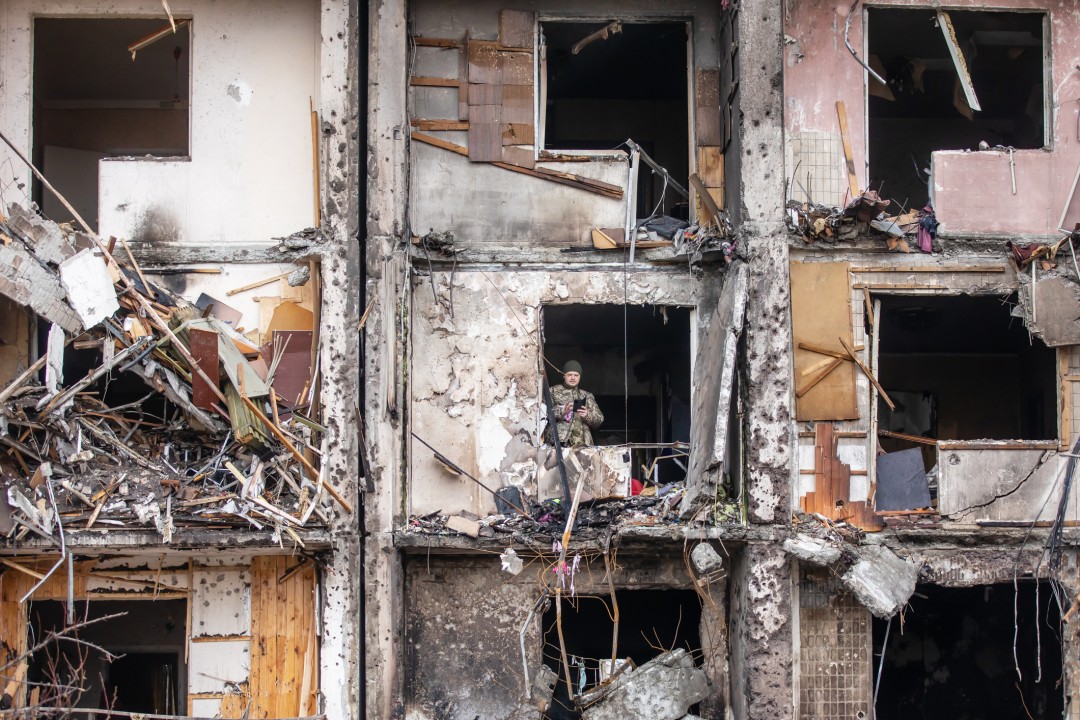
Man searching through bombed-out apartment building in Kyiv
A residential building damaged by an enemy aircraft in the Ukrainian capital Kyiv. Photo credit ID 242226295 © Palinchak | Dreamstime.com

How the War in Ukraine Affects the Global Economy

0
By Michele Wucker on March 22, 2022 The Horn

Russia avoided default on its foreign debt by paying bondholders $117 million, producing at least a temporary sigh of relief. The ability to pay creditors is just one of the economic impacts of Russia’s invasion of Ukraine. More broadly, the repercussions include a drag on a global economy already struggling to emerge from the Covid-19 pandemic; the hit of sanctions; the loss booked by companies withdrawing from Russia; and price spikes in commodities markets.

Supply-chain breakdowns affecting availability of wheat, fertilizer, and other key agricultural products could lead to a humanitarian as well as economic shock. Then there also are the ever-mounting costs of rebuilding once the hostilities stop, the lost productivity, the empty shelves and lost jobs, and exchange-rate shocks.

I won’t belabor the impact on global energy markets, which has been extensively covered. But energy is a significant part of the war’s contribution to already-high inflation, to which the commodities and supply-chain shocks described above will contribute.

The full extent of the economic damage will depend on how much longer the war continues and many other factors. Nevertheless, observers are trying to assess possible scenarios based on what we know now. Here are quick snapshots –by no means exhaustive– of estimates of the extent of the looming economic issues.

Direct Bank Exposure

There are, of course, the default worries. Though the prospect raises the ghosts of Russia’s 1998 default, today’s situation is different. Russia’s hard currency reserves are more than enough to cover its obligations. Sanctions loopholes created will allow Russia to make good on its obligations last through May 25.

“As of last summer, banks headquartered outside Russia had a little more than $100 billion of direct exposure to borrowers in Russia net of risk transfers, plus nearly $50 billion in exposure through derivatives, credit commitments, and guarantees,” Matt Klein wrote in his excellent Substack newsletter, The Overshoot, citing the Bank for International Settlements. This is down sharply from before Russia’s 2014 invasion of Crimea, which prompted many banks to reduce their exposure. In 2013 US, European, and Japanese banks held more than $250 billion in claims net of risk transfers as well as around $200 billion in other exposure. (This includes not just Russian government debt but also corporate debt.)

Russia has more than enough reserves to keep paying on its roughly $62.5 billion in foreign debt, including $21.5 billion that it must pay in dollars and euros.

The recent payment is an encouraging sign that the country wants to continue engaging with global markets and meeting its financial commitments. But the question remains: will it continue to want to do so? It’s also unclear whether Russian leader Vladimir Putin will make good on his threat to pay creditors in devalued rubles, which would mean a default on the terms of the borrowing agreements. Another $2.86 billion is due by April 4, and developments in the conflict could easily change Russia’s stance.

That’s why bankers are already discussing the very real likelihood that some part of Russia’s international obligations will need to be written off.

Global Economic Tremors

 A recent JP Morgan research note predicted that the Russian economy would contract by 35% in the first and second quarters of 2022 compared to 2021, and at least 7% for the full year. “Inflation could end the year at around 14%, up from 5.3% forecasted before the crisis, with risks skewed heavily to the upside due to ruble depreciation and import shortages.

Sanctions on Russia, inflation, and market and supply disruptions will cost the global economy as well. JP Morgan revised its global 2022 economic projections March 10 to reflect its estimate that the war will knock 1.5% off of global GDP and add 3% to inflation.

Corporates Withdrawing from Russia

The European civic organization The Good Lobby and Progressive Shopper, which tracks political contributions, have created the Ukraine Corporate Index to track global companies’ stances toward Russia. In response to corporate withdrawals, Russia has published a list of 59 Western companies that could be nationalized, including McDonald’s, Starbucks, EY, Ikea, Volkswagen, Toyota, and Shell.

The impacts on individual companies could be significant —as I noted recently, BP has estimated that it could have to write off as much as $25 billion because of its divestment from Russia could– but in most cases still represent a manageable portion of their overall business.

The 46 countries that enacted sanctions on Russian cars, machinery, chemicals, pharmaceuticals, and other manufactured products had been supplying the country with more than half of its imports of these goods combined. Before these countries imposed sanctions, they had been exporting a combined $139 billion to Russia, according to a Washington Post analysis.

A Global Food Catastrophe

United Nations Secretary-General Antonio Guterres has warned of a “hunger hurricane” because of the war’s impact on fertilizers and agricultural trade. The impact would be particularly hard on North Africa and the Middle East; Egypt, for example, is the world’s biggest wheat importer and relies heavily on both countries. Indonesia is the world’s second largest buyer of Ukrainian wheat. Pakistan, Turkey, and several countries in Central Asia and sub-Saharan Africa depend on Ukrainian and Russian wheat as well. 

Similarly, Paul Polman and Eratharin Cousin warn in a recent analysis that a global food catastrophe is looming. In normal times, Russia and Ukraine together produce between 20% and 30% of the world’s wheat, depending on whom you ask and on the harvest in question. They also are major producers of corn, sunflower oil, and barley. They export nutrients such as potash and nitrogen for fertilizer. “While important agricultural goods including seeds and fertilisers are not officially subject to international sanctions, the food value chain is close to collapsing, putting up to 500 million people at risk of ‘collateral hunger’,” Cousin and Polman wrote. 

Ukraine typically produces 10% of global wheat exports, 14% of corn exports and about half of the world’s sunflower oil, according to the U.S. Department of Agriculture as cited in The Wall Street Journal [paywall]. Ukraine has already planted the spring wheat harvest but is having trouble getting fertilizers. Harvests of corn, sunflower and barley harvests, which normally happen in April and May, also are endangered. Taras Vysotskyi, Ukraine’s deputy minister of agrarian policy and food, told the Journal that the best-case scenario is that the country’s agricultural exports will fall by a fifth this year compared with 2021, but that a much steeper drop is more likely.

Should Russia and Ukraine completely stop wheat exports, it would result in serious shortages in many developing economies, “The disruption in fertiliser manufacturing risks making these disruptions more long lasting, by putting next years’ agricultural supply under stress,” the OECD, an international organization. reports.

Global supply chains

Russia and Ukraine also export key metals and gases, without which manufacturers elsewhere will have trouble finishing production and getting goods to market. “Russia is a key supplier of palladium, used in catalytic converters for cars, and nickel, used in steel production and the manufacture of batteries,” the OECD notes. “Russia and Ukraine are also sources of inert gases such as argon and neon, used in the production of semiconductors, and large producers of titanium sponge, used in aircraft. Both countries also have globally important reserves of uranium.”

It’s impossible to separate the economic impact from the humanitarian crisis, both the victims of the war and those who will suffer from hunger. Nevertheless, assessing the economic side-effects and finding ways to keep them from creating other tragedies remains important.

This article is part of my LinkedIn newsletter series, “Around My Mind” – a regular walk through the ideas, events, people, and places that kick my synapses into action, sparking sometimes surprising or counter-intuitive connections. 

To subscribe to “Around My Mind” and get notifications of new posts, click the blue button at the top right corner of this page. Please don’t be shy about sharing, leaving comments or dropping me a private note with your own reactions.

For more content, including guest posts and ways to engage me for keynotes, workshops, or strategic deep dives, please visit www.thegrayrhino.com.

  • Author
  • Recent Posts
Michele Wucker
Follow
Michele Wucker
Founder & CEO at Gray Rhino & Company
Michele Wucker is a policy and business strategist and author of four books including YOU ARE WHAT YOU RISK: The New Art and Science of Navigating an Uncertain World and the global bestseller THE GRAY RHINO: How to Recognize and Act on the Obvious Dangers We Ignore. Read more about her at https://www.thegrayrhino.com/about/michelewucker
Michele Wucker
Follow
Latest posts by Michele Wucker (see all)
  • Constructing cognitive models using the gray rhino risk framework - October 15, 2025
  • Substack Gray Rhino Wrangler Short Series: the Big Ugly Debt Gray Rhino - September 30, 2025
  • Kerala’s Landslide Grey Rhino - September 15, 2025
food crisis global economy Russia Ukraine
Share. Facebook Twitter Pinterest LinkedIn Tumblr Email
Michele Wucker
  • Website
  • Facebook
  • X (Twitter)
  • LinkedIn

Michele Wucker is a policy and business strategist and author of four books including YOU ARE WHAT YOU RISK: The New Art and Science of Navigating an Uncertain World and the global bestseller THE GRAY RHINO: How to Recognize and Act on the Obvious Dangers We Ignore. Read more about her at https://www.thegrayrhino.com/about/michelewucker

Related Posts

Substack Gray Rhino Wrangler Short Series: the Big Ugly Debt Gray Rhino

On Substack: Wrangling this Gray Rhino Rampage

Gray Rhino Risks and Responses to Watch in 2024

Comments are closed.

YOU ARE WHAT YOU RISK
YOU ARE WHAT YOU RISK Book Cover Click to order YOU ARE WHAT YOU RISK: The New Art and Science of Navigating an Uncertain World (Pegasus Books, April 6, 2021)
Book A Keynote or Workshop
Speakers Connect Sidebar Ad Book Gray Rhino & Company Founder & CEO Michele Wucker to speak at your next event. For more information  click on the logo  to contact Speakersconnect.

DCROI Risk Governance Institute
DCROI logo NEW! Earn the Mastering Gray Rhino Governance Certificate. Learn about DCROI's growing library of courses, networking, learning, and development opportunities focusing on the positive governance of risk-taking and the practical aspects of risk governance needed to pursue corporate goals and fulfill the purpose of our organizations.
BOOKSHOP.ORG STORE
Bookshop.org logo Shop at Bookshop.org and support independent booksellers. Browse our lists on business, decision making, current affairs, and more.
Leaderboard Ad
About
About

Gray Rhino® & Company provides a simple yet powerful framework, training and tools to help individuals, organizations, and communities to better counter and overcome obvious but too often neglected challenges in business, life, and the world.

Facebook LinkedIn
GRAY RHINO TRACKER Sign Up
Subscribe below for exclusive insights and updates in our monthly newsletter, The Gray Rhino® Tracker.

©2019
Gray Rhino & Company
4101 North Broadway, suite 104
Chicago, IL 60613-2104

  • About
  • Privacy Policy
  • Contact
©2016-2023 Gray Rhino & Company 5940 North Sheridan Road, Chicago, IL 60660
  • About
  • Privacy Policy
  • Contact

Type above and press Enter to search. Press Esc to cancel.

We use cookies on our website to give you the most relevant experience by remembering your preferences and repeat visits. By clicking “Accept”, you consent to the use of ALL the cookies.
Do not sell my personal information.
Cookie SettingsAccept
Manage consent

Privacy Overview

This website uses cookies to improve your experience while you navigate through the website. Out of these, the cookies that are categorized as necessary are stored on your browser as they are essential for the working of basic functionalities of the website. We also use third-party cookies that help us analyze and understand how you use this website. These cookies will be stored in your browser only with your consent. You also have the option to opt-out of these cookies. But opting out of some of these cookies may affect your browsing experience.
Necessary
Always Enabled
Necessary cookies are absolutely essential for the website to function properly. These cookies ensure basic functionalities and security features of the website, anonymously.
CookieDurationDescription
cookielawinfo-checkbox-analytics11 monthsThis cookie is set by GDPR Cookie Consent plugin. The cookie is used to store the user consent for the cookies in the category "Analytics".
cookielawinfo-checkbox-functional11 monthsThe cookie is set by GDPR cookie consent to record the user consent for the cookies in the category "Functional".
cookielawinfo-checkbox-necessary11 monthsThis cookie is set by GDPR Cookie Consent plugin. The cookies is used to store the user consent for the cookies in the category "Necessary".
cookielawinfo-checkbox-others11 monthsThis cookie is set by GDPR Cookie Consent plugin. The cookie is used to store the user consent for the cookies in the category "Other.
cookielawinfo-checkbox-performance11 monthsThis cookie is set by GDPR Cookie Consent plugin. The cookie is used to store the user consent for the cookies in the category "Performance".
viewed_cookie_policy11 monthsThe cookie is set by the GDPR Cookie Consent plugin and is used to store whether or not user has consented to the use of cookies. It does not store any personal data.
Functional
Functional cookies help to perform certain functionalities like sharing the content of the website on social media platforms, collect feedbacks, and other third-party features.
Performance
Performance cookies are used to understand and analyze the key performance indexes of the website which helps in delivering a better user experience for the visitors.
Analytics
Analytical cookies are used to understand how visitors interact with the website. These cookies help provide information on metrics the number of visitors, bounce rate, traffic source, etc.
Advertisement
Advertisement cookies are used to provide visitors with relevant ads and marketing campaigns. These cookies track visitors across websites and collect information to provide customized ads.
Others
Other uncategorized cookies are those that are being analyzed and have not been classified into a category as yet.
SAVE & ACCEPT