

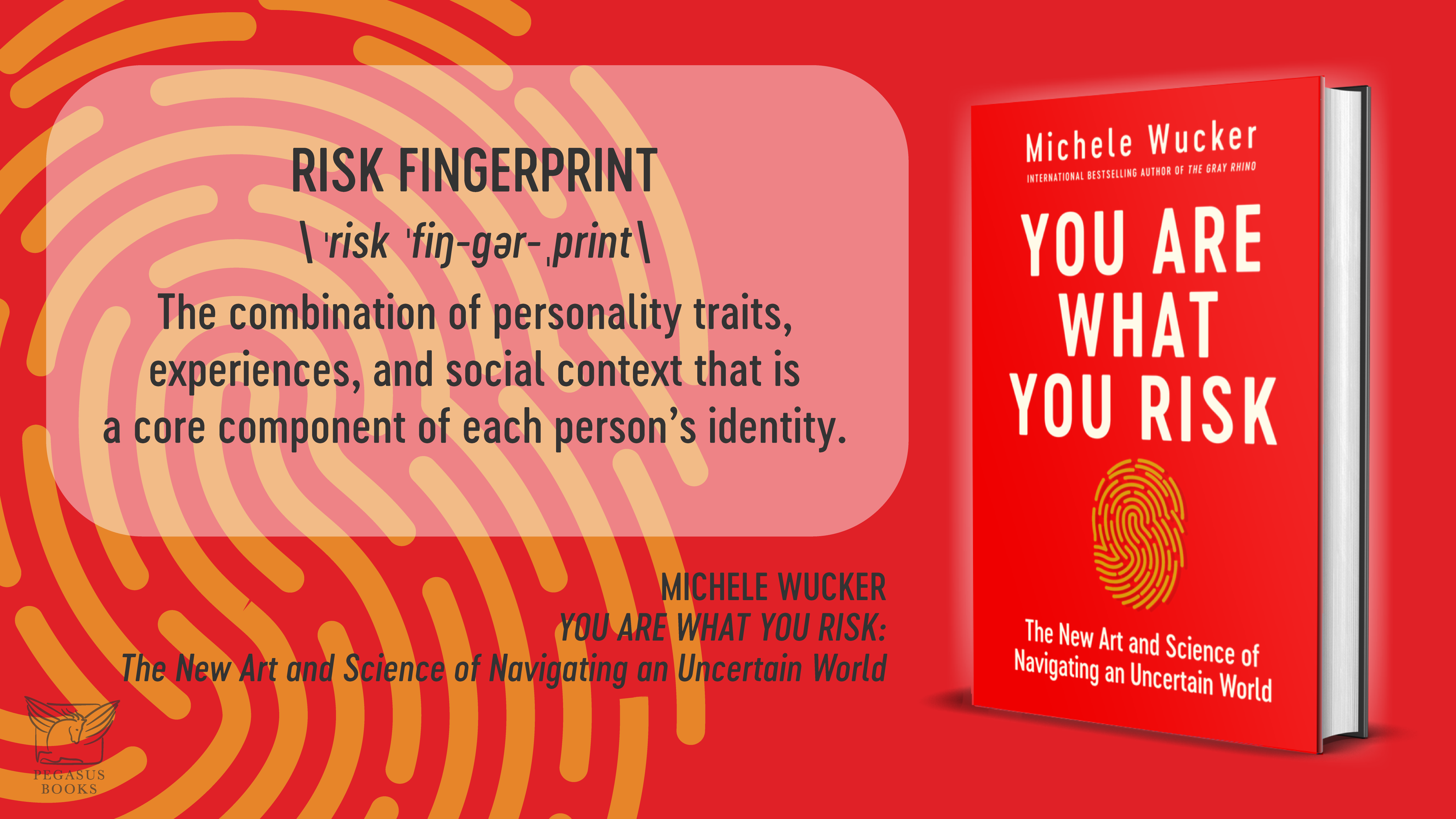
Adapted from Chapter 5 of YOU ARE WHAT YOU RISK: The New Art and Science of Navigating an Uncertain World (Pegasus Books, April 2021; international English edition via Simon & Schuster International, May 2021; paperback February 2023).
What is the biggest risk you’ve ever taken? Take a moment to think about the answer to this question. It doesn’t have to be starting a business or going around the world or reporting from a war zone. It could involve getting married, starting a family, changing careers, buying a house, getting a degree.
The answer will say a lot about who you are. Did you think of it as a choice? How did you feel about it as you were deciding whether or not to leap? Did you feel enthusiasm or fear? How do you feel now about the risk you took? Did you think of it as a risk when you took it, or only in hindsight? Did it turn out the way you had hoped? If not, with hindsight, would you have done it anyway?
The reasons we choose to face or ignore the dangers and opportunities in front of us may surprise as much as they enlighten. So many things shape how we perceive and rank risks: demographics, upbringing, career choices, religion, geography, culture, past experiences, generations, media, decision processes, organizational design . . . the list goes on. But unexpected factors—your height, what you look like, what you ate today, what language you speak, and what music you listen to—play a bigger role than you might think. Even the people who consider themselves to be highly rational are buffeted by emotions, cognitive biases, and the rush of hormones through our veins. We ignore them at our peril.
These often unconscious influences shape how sensitive we are to risks: that is, how likely we are to judge something as risky or not, how worried it makes us, and even whether we notice it at all. They mold our risk tolerance and attitudes: how much risk we think is worth bearing, and whether we distinguish between “good” risks—that is, opportunities like taking a new job or trying something for the first time—and “bad” or “dangerous” risks—like, say, making questionable bets with other people’s money or committing crimes. Finally, they affect whether or not we stay in our comfort zones and how we behave in the face of a risk. Heading off a risk can be risky in and of itself. So can staying in an extreme comfort zone by doing everything you can to avoid risks.
Each one of us has a risk personality that is as distinct as a fingerprint. Our risk fingerprints start with our underlying personality traits, which you might think of as the ridges, arches, loops, and whorls that give the fingerprint structure and make it distinctive. Our experiences alter the fingerprint much as a cut might leave a scar.
Just as a real fingerprint offers forensic analysts clues to identity, the risk fingerprint offers a window into who each of us is: how we feel about authority and power, about our sense of human agency, how we relate to each other in groups, and broader cultural differences that can make societies particularly risk sensitive or risk blind. It sheds light on what people hope and fear—and why—and how much power they feel they and their leaders have over the world around them.
RISK FINGERPRINT: The combination of personality traits, experiences, and social context that is a core component of each person’s identity.
After Entrepreneur magazine named Cindy Chin, a Taiwanese-born technology pioneer, one of “most daring” entrepreneurs of 2018, she told me that she didn’t think of herself as daring at all. In her mind, she was just following a path. When I asked her what the biggest risk was that she’d ever taken, her answer was intriguing: It was giving herself the permission to be happy. “When you’re faced with a choice, there’s an element of unknowing, an amount of naiveté, coming at it from the scientists’ point of view,” she said. “These moments bring you down a path and at some point, you either follow it or get off. The key is to show up: to get on the path in the first place.”
Her answer, and the stories I’ve shared in Chapter Four, illustrate some key principles behind how people’s risk fingerprints determine their futures. First, people may see risks as good or bad even though the same risk might appear to be precisely the opposite to someone else. Our experiences and personalities shape whether we look at risk in a positive or negative light, when in reality it is value neutral. Whether a risk is good or bad depends on what each person makes of it.
Second, risk-takers often don’t see their behavior as “risks” because risk involves a choice of options. For them the “risk” was the only feasible path, leaving them no other choice but to pursue it. People who are driven by whatever mysterious force of personality—whether curiosity, ambition, greed, or fear—choices often are so clear that there effectively is no real choosing to be done. They tended to be certain of where they needed to go, even though they may have no idea of the twists and turns that their path might take.
What motivates us? What do we think is worth taking a risk for? What will we take risks to avoid? After a crisis, do we become better at embracing good risks and avoiding bad risks, or do we shrink back from any risk at all? Why do some people shrivel up after a shock event, while others embrace risks with a newfound confidence? What makes the difference whether or not we can spring back from a risk gone terribly, terribly wrong?
The answers to these questions draw our risk fingerprints. Our innate personality traces the outline of how confident we are, how anxious or calm, how impulsive or methodical. Our experiences either accentuate or smooth out the inclinations that come to us naturally. The risk ecosystems around us further affect our feelings and actions; just like a glove might protect our hands, the safety nets or lack of them expand or restrict our risk choices. The habits we adopt and careers we choose further mold our risk fingerprints.
But just as the risk fingerprint is intimate, unique to each of us, it also is the product of the people who surround us. Let’s take a look now at some risk perceptions and attitudes common to different demographic groups.
When I asked a group of dynamic Chicago twenty-somethings what was the biggest risk they had ever taken, there was silence for a moment. Then one raised his hand: “I quit medical school to become a stand-up comic.” Even among a risk-tolerant group of entrepreneurs, consultants, strivers, and do-gooders, Agam Arora’s example was hard to beat. It also bucked the stereotype that the millennial generation is risk-averse.
His risk attitudes had been ingrained by Punjabi Hindu-Sikh immigrant parents, his father a cardiologist and mother a counseling psychologist, each with a thriving practice in Los Angeles. Despite their career choice, they advised their sons that becoming a doctor or lawyer, where you could expect to make a solid six figures, was not a good risk compared to starting a business, where you could make much more. Still, they prioritized their children’s happiness and fulfillment as the primary goal over any monetary gains. Their attitude questions the point of having made so many sacrifices if at the end their kids are unhappy. “My father also firmly believes that we should endeavor to be the best at whatever it is we decide to do, and the money will follow naturally once we get to that level of expertise,” Arora told me.
Their attitude contrasted with typical attitudes among first-generation immigrants, who often urge their children—the first generation born in the host country—to pursue professions like doctor or engineer that they perceive as being more stable and less uncertain than their own path was. As a group, immigrants tend to be perceived as risk-takers by virtue of the act that defines them: leaving behind a life in one country to start a new one in a foreign land, often one that is hostile to immigrants and where people speak a different language.
That’s why they have tended to prefer stability for their children rather than the potentially greater income. Their grandchildren—the second generation born in the host country—tend to be the ones who re-embrace risk and go on to become entrepreneurs.
I met with Arora over coffee to hear his full story, which in some ways was more in keeping with that traditional first-generation story than I had expected. But it also shed light on how socioeconomic status, community, and circumstances shape what and how we think about risk.
Arora originally had wanted to be a writer, a discipline he studied as an undergraduate at Syracuse University along with biology, with his parents’ blessing. During college he had done some stand-up and found it to be a great outlet for his writing. But he graduated into the chaos of the global financial crisis in spring 2009. Even in good times, writing jobs are not the easiest to come by nor by far the best paid. And the unstable economy made him deeply anxious. He told me: “I was asking myself, ‘Will I say no to a family business that’s up and running?’”
With that in mind, he took a job doing research for UCLA as preparation for medical school and was accepted to a program based in the Caribbean island of Dominica. Once he was there, however, it quickly became obvious that he was “a car in the wrong race,” as he put it. At the end of the first year, he found out that he’d been accepted to a much stronger program at a prestigious school in the United States. He struggled with what to do, but ultimately knew deep down that it was not for him. His brother, who had taken their parents’ advice and gone into venture capital, advised Arora not to worry about the sunk costs of his year in medical school. That was liberating, and helped him decide to return to Los Angeles, where he threw himself back into the creative life. He signed up for a stand-up class and cobbled together a series of odd jobs to support himself: “a lot of weird Craigslist gigs” selling knives, ghostwriting, and eventually a full-time job as a career counselor.
He spent his evenings at comedy shows, practicing material that his older self now finds cringeworthy, and doing a lot of waiting around for those brief moments of euphoria behind the microphone. “It was awesome and terrifying,” he said. “I liked being good at it, but I hated being the center of attention.”
That meant he had to face the music once again. A family friend connected him with a job at DirecTV that gave him business experience. At the same time, he threw himself into his parents’ philanthropy supporting schoolchildren in rural India. Then lightning struck, so to speak. After a young girl at one of the schools died of malaria, he decided to try to solve a problem that had kept her and many other young malaria victims from getting help in time. In overcrowded schools, teachers rarely noticed symptoms quickly, which meant that by the time a child with malaria made it to the hospital, they already were on borrowed time. The didn’t have two weeks to wait for blood tests to determine which strain to treat. The worst part was that in many cases, foundations had provided the medicine that could save children, but it sat idle on shelves in the schools.
With his biotech and medical experience, Arora put together a plan to use rapid diagnostic tests that could identify the strain within twelve hours so that children could get the treatment they needed to stay alive. He left his job and went to India to pilot a project to use those tests to help children in immediate need of care and to collect data that foundations could use to distribute the most effective medications.
It was a learning process, like the time he didn’t think ahead to realize that he would need power banks so that his laptop would work when collecting data in communities without electricity. Even so, his team got nearly five hundred children tested when they came to the grim realization that the test kits he’d bought were faulty and the data was no good. He kicked himself over his decision to buy the cheaper kits instead of the more expensive ones. That’s when he realized he needed business skills.
By the time I met him, Arora was working as a business analyst after completing an MBA degree at Northwestern University’s Kellogg School of Management. On the side, he was working on a social enterprise to help homeless people access health care and other services. It had been a long, winding, uncertain path, but the risks that Arora took got him to where he needed to be.
Though he could tolerate the uncertainty that often goes hand in hand with creative personalities, it’s impossible to separate his story from the people around him—for better and for worse. Arora had a supportive family who provided a safety net that gave him the freedom to fail forward. His aunt taught him the scientific approach he needed, his parents backed him financially, and his brother and cousins supported him with advice and encouragement. He felt the expectations of the Indian community to become a fully formed person who knew his strengths and wasn’t afraid to apply them.
His biggest misstep, ironically, had been in pursuing the supposedly “less risky” alternative of medical school. It goes to show just how important it is to understand how closely your risk decisions are tied to how the people around you see risk, and how well you understand how much of your thought process comes from you and how much from the collective influence and expectations of those around you.
Adapted from YOU ARE WHAT YOU RISK: The New Art and Science of Navigating an Uncertain World. Original hardcover edition released April 6, 2021 from Pegasus Books; paperback February 2023.
This article is part of my LinkedIn newsletter series, “Around My Mind” – a regular walk through the ideas, events, people, and places that kick my synapses into action, sparking sometimes surprising or counter-intuitive connections. Subscribe to “Around My Mind” on LinkedIn to get notifications of new posts. Please don’t be shy about sharing, leaving comments or dropping me a private note with your own reactions.
- Constructing cognitive models using the gray rhino risk framework - October 15, 2025
- Substack Gray Rhino Wrangler Short Series: the Big Ugly Debt Gray Rhino - September 30, 2025
- Kerala’s Landslide Grey Rhino - September 15, 2025
